Well. The last time we talked I said the data wasn’t conclusive on what was going on. And that we should wait a couple weeks for more data. Since then, the World Health Organization has released 14 more Situation Reports. They also got around to naming the disease, so 2019-nCoV is now COVID-19. Now that we’re here, in the future, some things are more clear, some are still hard to decide on.
Healthcare Data Reliability
Two weeks ago, the data on Hubei Province wasn’t conclusive on whether or not a real slowdown was occurring or whether the healthcare system was so overwhelmed at that point in the outbreak that it was unable to confirm all existing cases. Less than a week later, we got a resounding answer that this was exactly what was happening. China, along with the WHO switched to including “clinically diagnosed” cases along with lab confirmed cases for this Province and included a backlog of over 15,000 cases that they assessed clinically as COVID-19, but had not had the capacity to confirm by PCR in a laboratory.
So, the outbreak outstripped the ability of the local healthcare system to test for it. This is an unsurprising outcome. It’s actually quite impressive that amidst a crisis that was admitting thousands of new cases per day, the Chinese healthcare system was laboratory confirming most of those thousands of them for so long. As a point of comparison, the United States, despite warning and few active cases in its borders, appears to have a testing capacity of about tens of samples per day—nationwide. The CDC in this country requires centralized testing for final confirmation and has rolled out their own version of the test to labs which is required for confirmation. It is, as of yet, not going well:
Only three of the more than 100 public health labs across the country have verified the CDC test for use, according to the Association of Public Health Laboratories.
https://www.politico.com/news/2020/02/20/cdc-coronavirus-116529
Other governments are different spots on the spectrum and the results here appear to be highly variable. More on this below.
China
Despite what we just covered, there’s no solid conclusion on the state of the situation in China. While the healthcare system is definitely overwhelmed in some places, the data that does exist in Hubei even shows signs of improvement. The same is happening outside Hubei. Here’s what things look in China outside of Hubei Province according to the official data:
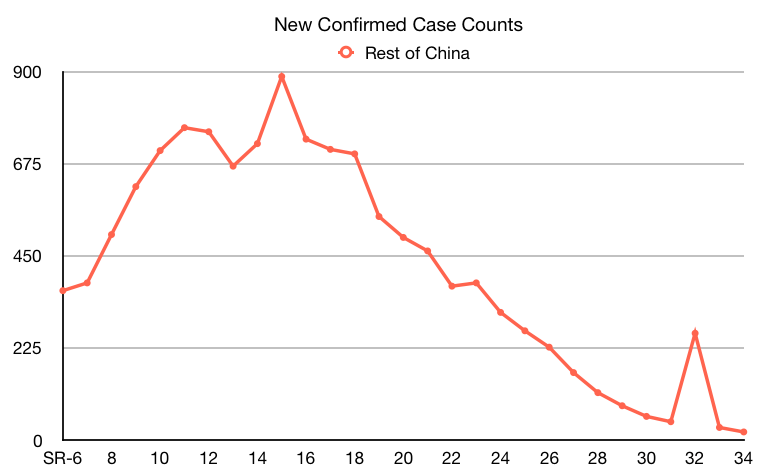
This is miraculous.
If true.
It is admittedly hard to believe that the new cases could go down across the entire country so evenly quite like so. These numbers are reflected similarly at the province by province level. One conclusion is that the rather strict and heavy handed quarantine measures employed by the government and generally followed by the communities involved have been effective. Another conclusion is that some parts of the country may have simply stopped detecting new cases, for one reason or another.
This is still an area where we’ll need to give things time. In an overwhelmed healthcare system the new case counts would top out at the level the healthcare system could detect them and stay there, but in this case the data shows them outright dropping. This points towards the possibility of a real improvement. It’s hard to know what data is right or how the reporting is working on the ground. Our other source of data, the fatality data has not yet shown the same level of deceleration. But it’s also unclear whether we’d expect it to at this point.
Outside China
Outside China the situation is clear. Things are getting worse. So much so that this latest round of datapoints outright broke my model. COVID-19 is no longer an outbreak focused on one country. This is clearly moving towards a global pandemic.
Here’s what happened in the last few days outside China in the rest of the world:
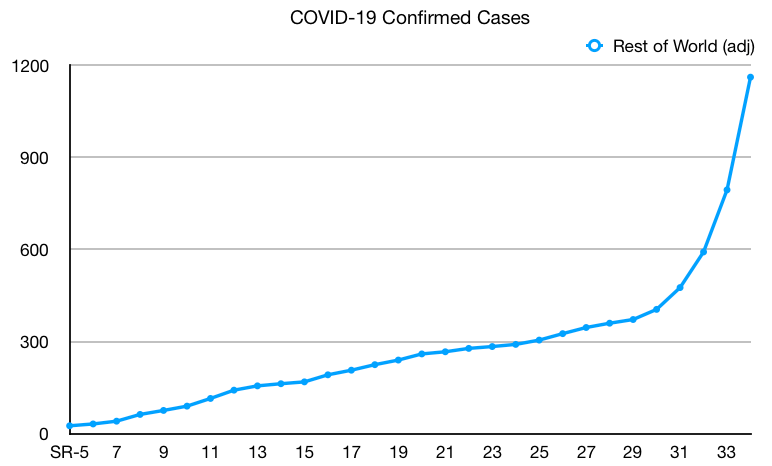
The graph above is without the weird cruise ship that was reporting tons of cases sporadically. Hence the “Rest of World (adj)” notation. If you don’t like excluding the cruise ship from these numbers, we can add it back and you’ll still see this unfortunate exponential curve forming:
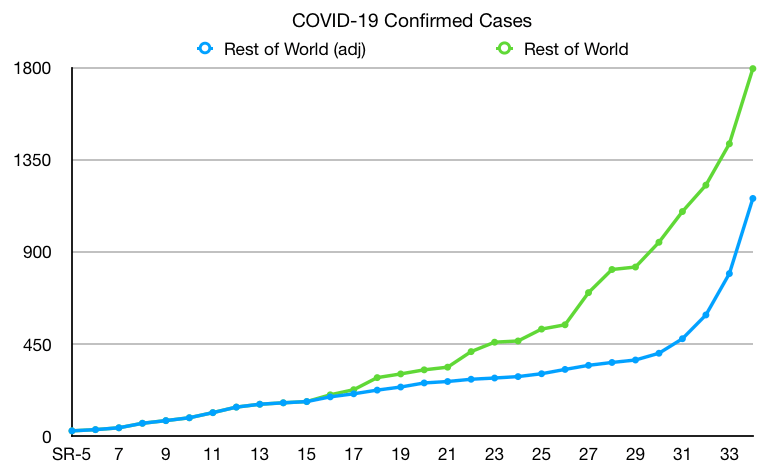
These are primarily driven by local transmission from outbreaks in South Korea, Japan and Italy. There’s also a minor new-ish outbreak in Iran. Singapore has case numbers in a similar range, but the outbreak here has been happening for longer and this country has been exhaustively working to find, trace, and quarantine those who have COVID-19.
If that was the end of the story, we could potentially look past three separate countries across multiple continents reporting new major outbreaks in the span of three days. We could pull ourselves together and perhaps see a way to decide this isn’t necessarily going to end in a pandemic. We could get there.
But during an outbreak and global public health crisis, we have to read between the lines in the data. These countries are reporting spikes. These countries are also the countries that are broadly testing for COVID-19.
In my last post, I was worried about discovering outbreaks in countries that struggle with healthcare relative to other countries. I was concerned that we wouldn’t discover things until after the fact, because by the time we noticed the outbreak it would be fairly widespread. This concern seems accurate. Unfortunately it also seems optimistic.
We’re finding similar situations in countries with top-tier healthcare systems. These are likely the ones we are finding earlier than we will later find in other countries. Given this, it seems unlikely that we contain widespread COVID-19 outbreaks to any specific country, or even specific sets of countries.
Hence, COVID-19 seems likely to become a pandemic.
I expect that most people will begin referring to it as one within the next two weeks.
Don’t Panic
It won’t help.
If you do decide you need to purchase something or stock up, please do so in limited quantities. It’s absolutely appropriate to send the market signals that there might be a need for more non-perishable food and other goods in the future. But if everyone goes out to try and buy a ton, we’ll run out due to sheer panic alone rather than real lack of supply. Be gentle with yourselves, each other, and your supply chains. There are many humans and this will go better if we do not all panic at once.
If you must, take turns.
Also: if what China is doing is actually working, we may all want to consider doing some of what they’ve done to fight this disease.
 Rank Amateur Epidemiology Hour