Yesterday’s trends continue in today’s data:
- The situation in Hubei Province continues to accelerate.
- The situation in China outside Hubei Province shows signs of an effective response as the exponential growth rate in this population continues to slow.
- The situation in the Rest of the World shows signs of an ineffective response as the exponential growth rate in this population continues to rise.
Key Stats

I’m going to do something new today, which I haven’t done before. I’m going to report the estimates of my fatality model. I think since I keep reading folks on the Internet compare this to SARS, MERS and the flu and try and rationalize this as being small potatoes in comparison, it’s time to talk fatality numbers.
Let’s start comparison wise quickly: For the former two, SARS and MERS the outbreaks were never this widespread. For the flu, I think it needs to just be stated that the flu is rather bad. That it already happens to kill a lot of people each year isn’t a great comfort, nor something to inspire apathy. The outbreak of new flu strains is something that the WHO has spent considerable time and effort preparing against.
I think people tend to underestimate the flu, often because most people who think of having the flu, or someone else having the flu, don’t actually think of a case of an actual influenza infection. People use the word “flu” to describe a set of symptoms, many cases of which aren’t actually caused by a real case of influenza, but rather some milder sickness with similar symptoms.
Today’s table lists the number of people the current model predicts may die of 2019-nCoV before August if we do not have a treatment or vaccine intercept before that time:
| Stat | Current | Yesterday | Change |
|---|---|---|---|
| Hubei – Exp Co-Efficient | 2.18 | 2.13 | +.05 |
| Hubei – Half Pop Spread Estimate | 13 Months | 14 Months | -1 Month |
| Rest of China – Exp Co-Efficient | 1.33 | 1.37 | -.04 |
| Rest of World – Exp Co-Efficient | 1.19 | 1.13 | +.06 |
| 6 month fatality estimate (if no improvement in treatment protocol) | 60,677 | 57,509 | +3,168 |
Development of a vaccine or treatment protocol changes everything here. Health professionals and scientists are hard at work on developing both. There will definitely be a successful intercept between the growth rate of 2019-nCoV and medical intervention, the big question is how long it takes to produce enough medicine, effectively distribute it, and the number of cases and fatalities that occur in the meantime.
Hubei Province
The situation in Hubei Province remains severe as the response efforts fight to slow the rate of growth of the rate of growth. (Yes, I meant all those words.) We’re seeing some signs of discontent in the area. A notable doctor died today in Wuhan who was one of the scientists who discovered 2019-nCoV early in the outbreak. He was an early reporter of the outbreak, was ignored / punished by the authorities, and then after catching 2019-nCoV scientifically, caught it personally. His death has triggered widespread outrage, and harsh criticism that is unusual for the area. Unrest at this point given the strict widespread quarantine measures in place isn’t a surprising outcome, but doesn’t seem likely to make response efforts easier.
While the criticism that the government should have taken the outbreak more seriously earlier may have merit. And criticism about punishing a doctor for speaking up certainly does (the doctor allowing the world to respond to the outbreak earlier), when it comes to current on the ground policy changes it’s hard to think of any good additional more aggressive measures they could take at this point. Which unfortunately seems to leave both the frustrated residents and the government in a bad place to resolve or change much here.
With some local sentiment shifting, widespread sentiment internationally is also catching some increased criticism of the Chinese government. People continue to question the accuracy of the data being released. We talked about this a few days ago. As a brief update, my data continues to show no divergence in the models for reported deaths and confirmed case counts. Which means that if there’s underreporting of the data going on, it’s remarkably consistent underreporting. Perhaps it is easier to believe that the data really is consistent than it is to believe that thousands and thousands of cases are being hidden.
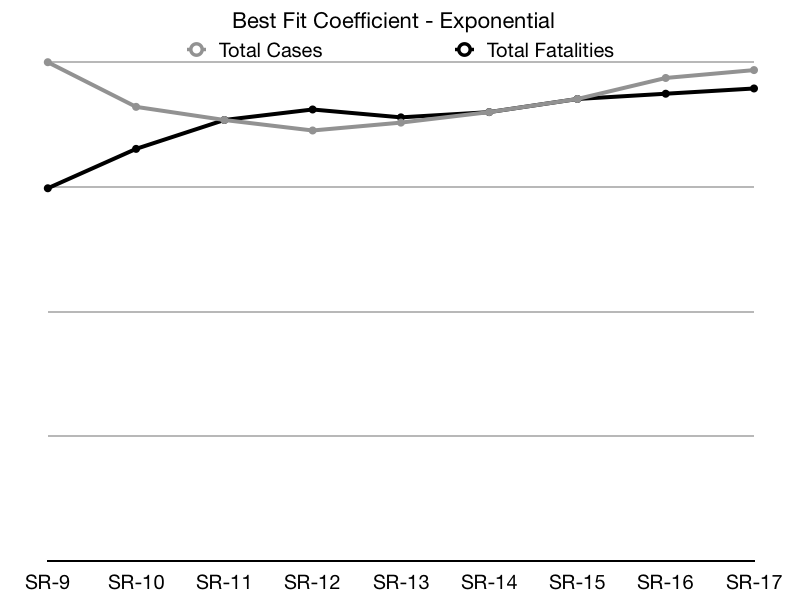
But I’m just a rank amateur here. At least several public health professionals seem to outright assume underreporting is occurring. Along with a lot of people who simply don’t trust the Chinese government and point to places in the past where that distrust was justified. I don’t know that there’s tons of basis for these claims, but my models are only as good as the data I provide them, so it’s important to point out that others may make different assumptions about the reliability of this data.
Rest of China & Rest of World
This category continues to be a surprise to me. While China has a massive logistics problem on their hands, they are successfully lowering the spread rate in the population outside Hubei Province. And unfortunately, at least according to this latest data, the same may not be true of the countries outside China. While the exponential curve that best fits the data is still steeper in China (even outside Hubei), the trend of those changes is moving slowly but steadily to intercept and become shallower than in the countries outside China. This would be a serious shame, because in absolute numbers there’s just so many fewer cases in the Rest of World population and an effective response seems, in some ways, like it should be a more tractable problem outside the main outbreak areas.
Ultimately it will be unsurprising if this does occur. Coordination problems are significantly harder with 23 countries than they are with one and even with fewer cases, that may cause enough problems to prevent an effective response. Perhaps in the fullness of time we should consider this an indictment of the way our political systems are too often structurally deficient at solving global problems.
 Rank Amateur Epidemiology Hour