Some highlights today:
- The situation in Hubei province continues to accelerate.
- Chinese measures to contain and respond to the outbreak continue to slow down the exponential growth rate of 2019-nCoV in the country outside Hubei Province.
- The Rest of the World continues to experience a relatively much slower growth rate of 2019-nCoV. More cases are now from local transmission or other countries than are imported from China.
China
The situation in Hubei continues to accelerate. Yesterday I discussed how my models make predictions for when half the population would be infected and that time is down to 18 months for Hubei’s population. With today’s additional datapoint the new curve that fits best yields a prediction of 14 months. The exponential rate continues to advance upward, with the exponential co-efficient of the best fitting curve having advanced again today from 1.99 yesterday to 2.13 today.
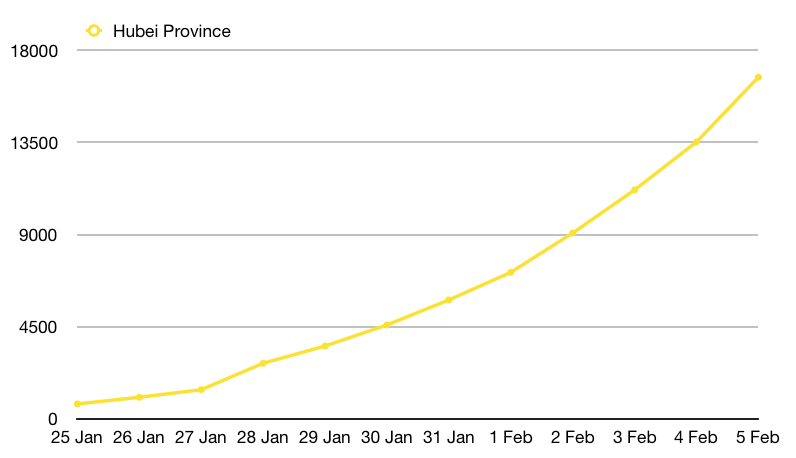
It is difficult to understand what an effective response looks like at this point in the outbreak with this model. Tomorrow, the amazingly built-in-only-ten days Leishenshan Hospital opens 1,500 new hospital beds. The statistical model predicts that in the 24 hours following the opening, at least two new cases of 2019-nCoV will be confirmed for each of the new beds. Currently only about 13% of confirmed cases are classified as “severe” but the stage of the response is definitely one in which even confirmed cases of 2019-nCoV will need triage to pick and chose which ones are severe enough to get hospital beds in the facilities designed to contain the outbreak—and which are not. The remainder of the cases will have to go to quarantine elsewhere. And the very next day there will be even more new confirmed cases, without the benefit of a new hospital.
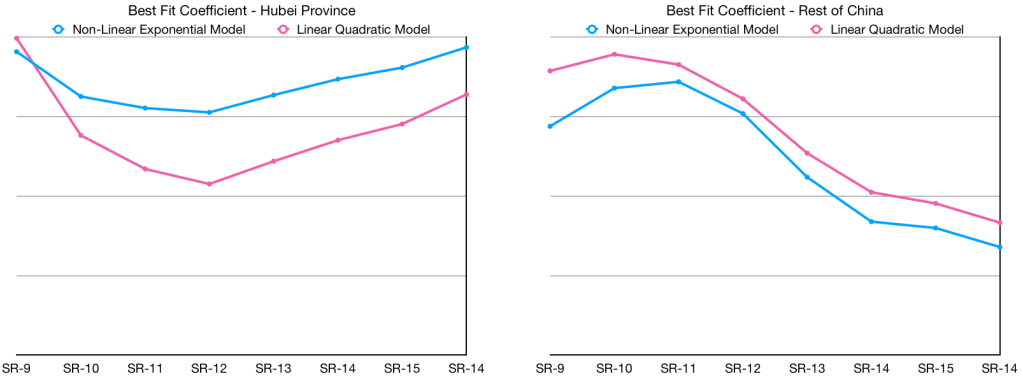
Somehow, despite the severity of the situation in Hubei Province, the situation in the Rest of China manages to remain surprisingly different. A slowing of the exponential growth rate in this population continued for a fifth day. That the exponential growth rate can be slowing elsewhere while the situation in Hubei continues to accelerate is a credit to the millions of people of China who are following public health protocols and maintaining containment measures, along with the amazing public health officials working on this problem in those countries.
Elsewhere
Outside China we continue to see a case growth rate that is closer to linear than exponential. The sharp limitations on travel appear to have resulted in only a small number of new cases resulting in travel from China to other countries. Unfortunately local human-to-human transmission continues to spread 2019-nCoV elsewhere. The WHO broke down the numbers of new cases by travel history ain this report and the data is illuminating. Out of the cases discovered in the last 24 hours outside China with known travel histories:
10travelled to China and are presumed to have caught 2019-nCoV there.21have no history of travel to China, and caught it from local human-to-human transmission, or from human-to-human transmission in another country outside of China.
The good news is the exponential growth rates of the subpopulations of 2019-nCoV cases are still quite divergent. Which means that the other outbreaks are not currently seeing the same human-to-human transmission rate that’s happening in Hubei Province.
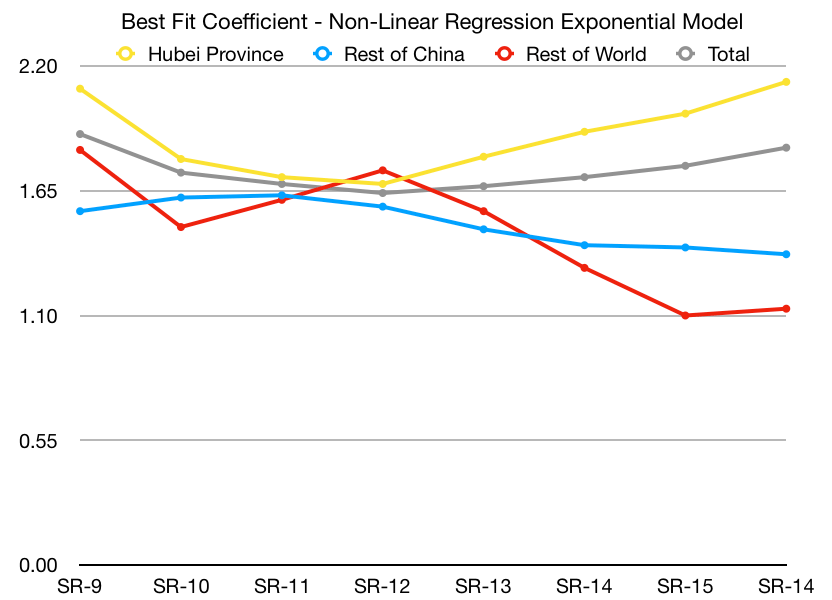
But it’s not quite as good of news as it was yesterday. Yesterday this data continued to indicate a drop in the exponential growth rate for 2019-nCoV cases in the Rest of World population. This model was nearly to the point where it fit a linear curve better than an exponential one. Unfortunately that didn’t repeat today. We’re moving back onto an exponential curve, if a comparably slight one. Given the scale of the problem China is currently managing, the rest of the world needs to work together on the clusters outside of China. In the cases that a healthcare system needs help, larger countries with advanced healthcare systems should be stepping in to provide what’s needed. Supporting China’s efforts are also critical and deeply necessary—but, it would be a shame to restrict movement to such a degree on people leaving China and not manage take care of our own much smaller outbreaks.
 Rank Amateur Epidemiology Hour